Class MenuModel
- All Implemented Interfaces:
Proxy
- Direct Known Subclasses:
DBusMenuModel,Menu,MenuModel.MenuModel$Impl
GMenuModel represents the contents of a menu — an ordered list of
menu items. The items are associated with actions, which can be
activated through them. Items can be grouped in sections, and may
have submenus associated with them. Both items and sections usually
have some representation data, such as labels or icons. The type of
the associated action (ie whether it is stateful, and what kind of
state it has) can influence the representation of the item.
The conceptual model of menus in GMenuModel is hierarchical:
sections and submenus are again represented by GMenuModels.
Menus themselves do not define their own roles. Rather, the role
of a particular GMenuModel is defined by the item that references
it (or, in the case of the ‘root’ menu, is defined by the context
in which it is used).
As an example, consider the visible portions of this menu:
An example menu
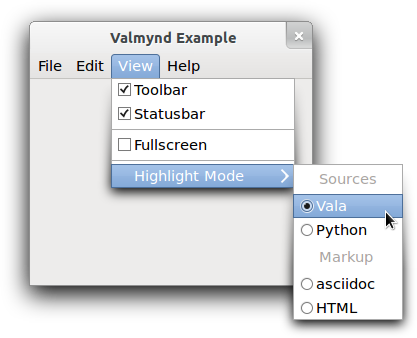
While this kind of deeply nested menu is no longer considered good UI
practice, it serves as a good example of the concepts in GMenuModel.
There are 8 ‘menus’ visible in the screenshot: one menubar, two
submenus and 5 sections:
- the toplevel menubar (containing 4 items)
- the View submenu (containing 3 sections)
- the first section of the View submenu (containing 2 items)
- the second section of the View submenu (containing 1 item)
- the final section of the View submenu (containing 1 item)
- the Highlight Mode submenu (containing 2 sections)
- the Sources section (containing 2 items)
- the Markup section (containing 2 items)
The example illustrates the conceptual connection between these 8 menus. Each large block in the figure represents a menu and the smaller blocks within the large block represent items in that menu. Some items contain references to other menus.
A menu example
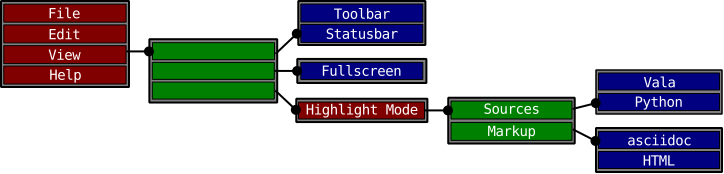
Notice that the separators visible in the example appear nowhere in the menu model. This is because separators are not explicitly represented in the menu model. Instead, a separator is inserted between any two non-empty sections of a menu. Section items can have labels just like any other item. In that case, a display system may show a section header instead of a separator.
The motivation for this abstract model of application controls is
that modern user interfaces tend to make these controls available
outside the application. Examples include global menus, jumplists,
dash boards, etc. To support such uses, it is necessary to ‘export’
information about actions and their representation in menus, which
is exactly what the action group exporter and the menu model exporter do for
ActionGroup and MenuModel. The client-side
counterparts to make use of the exported information are
DBusActionGroup and DBusMenuModel.
The API of GMenuModel is very generic, with iterators for the
attributes and links of an item, see
iterateItemAttributes(int) and
iterateItemLinks(int). The ‘standard’ attributes and
link types have predefined names: G_MENU_ATTRIBUTE_LABEL,
G_MENU_ATTRIBUTE_ACTION, G_MENU_ATTRIBUTE_TARGET, G_MENU_LINK_SECTION
and G_MENU_LINK_SUBMENU.
Items in a GMenuModel represent active controls if they refer to
an action that can get activated when the user interacts with the
menu item. The reference to the action is encoded by the string ID
in the G_MENU_ATTRIBUTE_ACTION attribute. An action ID uniquely
identifies an action in an action group. Which action group(s) provide
actions depends on the context in which the menu model is used.
E.g. when the model is exported as the application menu of a
GtkApplication,
actions can be application-wide or window-specific (and thus come from
two different action groups). By convention, the application-wide actions
have names that start with app., while the names of window-specific
actions start with win..
While a wide variety of stateful actions is possible, the following is the minimum that is expected to be supported by all users of exported menu information:
- an action with no parameter type and no state
- an action with no parameter type and boolean state
- an action with string parameter type and string state
Stateless
A stateless action typically corresponds to an ordinary menu item.
Selecting such a menu item will activate the action (with no parameter).
Boolean State
An action with a boolean state will most typically be used with a ‘toggle’
or ‘switch’ menu item. The state can be set directly, but activating the
action (with no parameter) results in the state being toggled.
Selecting a toggle menu item will activate the action. The menu item should be rendered as ‘checked’ when the state is true.
String Parameter and State
Actions with string parameters and state will most typically be used to
represent an enumerated choice over the items available for a group of
radio menu items. Activating the action with a string parameter is
equivalent to setting that parameter as the state.
Radio menu items, in addition to being associated with the action, will have a target value. Selecting that menu item will result in activation of the action with the target value as the parameter. The menu item should be rendered as ‘selected’ when the state of the action is equal to the target value of the menu item.
- Since:
- 2.32
-
Nested Class Summary
Nested ClassesModifier and TypeClassDescriptionstatic classMenuModel.Builder<B extends MenuModel.Builder<B>>Inner class implementing a builder pattern to construct a GObject with properties.static interfaceFunctional interface declaration of theItemsChangedCallbackcallback.static classThe MenuModel$Impl type represents a native instance of the abstract MenuModel class.static classNested classes/interfaces inherited from class org.gnome.gobject.GObject
GObject.NotifyCallback, GObject.ObjectClass -
Constructor Summary
ConstructorsConstructorDescriptionCreates a new MenuModel.MenuModel(MemorySegment address) Create a MenuModel proxy instance for the provided memory address. -
Method Summary
Modifier and TypeMethodDescriptionprotected MenuModelasParent()Returns this instance as if it were its parent type.voidemitItemsChanged(int position, int removed, int added) Emits the "items-changed" signal.booleangetItemAttribute(int itemIndex, String attribute, String formatString, Object... varargs) Queries item at positionitemIndexin this MenuModel for the attribute specified byattribute.protected voidgetItemAttributes(int itemIndex, Out<HashTable<String, Variant>> attributes) Gets all the attributes associated with the item in the menu model.@Nullable VariantgetItemAttributeValue(int itemIndex, String attribute, @Nullable VariantType expectedType) Queries the item at positionitemIndexin this MenuModel for the attribute specified byattribute.@Nullable MenuModelgetItemLink(int itemIndex, String link) Queries the item at positionitemIndexin this MenuModel for the link specified bylink.protected voidgetItemLinks(int itemIndex, Out<HashTable<String, MenuModel>> links) Gets all the links associated with the item in the menu model.static MemoryLayoutThe memory layout of the native struct.intQuery the number of items inmodel.static @Nullable TypegetType()Get the GType of the MenuModel classbooleanQueries if this MenuModel is mutable.voiditemsChanged(int position, int removed, int added) Requests emission of theGMenuModel::items-changed signal onmodel.iterateItemAttributes(int itemIndex) Creates aGMenuAttributeIterto iterate over the attributes of the item at positionitemIndexinmodel.iterateItemLinks(int itemIndex) Creates aGMenuLinkIterto iterate over the links of the item at positionitemIndexinmodel.Emitted when a change has occurred to the menu.Methods inherited from class org.gnome.gobject.GObject
addToggleRef, addWeakPointer, bindProperty, bindProperty, bindProperty, bindPropertyFull, bindPropertyFull, bindPropertyWithClosures, bindPropertyWithClosures, builder, compatControl, connect, connect, connect, constructed, disconnect, dispatchPropertiesChanged, dispose, dupData, dupQdata, emit, emitNotify, finalize_, forceFloating, freezeNotify, get, getData, getProperty, getProperty, getProperty, getQdata, getv, interfaceFindProperty, interfaceInstallProperty, interfaceListProperties, isFloating, newInstance, newInstance, newv, notify, notify, notifyByPspec, onNotify, ref, refSink, removeToggleRef, removeWeakPointer, replaceData, replaceQdata, runDispose, set, setData, setDataFull, setProperty, setProperty, setProperty, setQdata, setQdataFull, setv, stealData, stealQdata, takeRef, thawNotify, unref, watchClosure, weakRef, weakUnref, withPropertiesMethods inherited from class org.gnome.gobject.TypeInstance
callParent, callParent, cast, getPrivate, readGClass, writeGClassMethods inherited from class org.javagi.base.ProxyInstance
equals, handle, hashCode
-
Constructor Details
-
MenuModel
Create a MenuModel proxy instance for the provided memory address.- Parameters:
address- the memory address of the native object
-
MenuModel
public MenuModel()Creates a new MenuModel.
-
-
Method Details
-
getType
-
getMemoryLayout
The memory layout of the native struct.- Returns:
- the memory layout
-
asParent
Returns this instance as if it were its parent type. This is mostly synonymous to the Javasuperkeyword, but will set the native typeclass function pointers to the parent type. When overriding a native virtual method in Java, "chaining up" withsuper.methodName()doesn't work, because it invokes the overridden function pointer again. To chain up, callasParent().methodName(). This will call the native function pointer of this virtual method in the typeclass of the parent type. -
getItemAttribute
public boolean getItemAttribute(int itemIndex, String attribute, String formatString, Object... varargs) Queries item at positionitemIndexin this MenuModel for the attribute specified byattribute.If the attribute exists and matches the
GVariantTypecorresponding toformatStringthenformatStringis used to deconstruct the value into the positional parameters andtrueis returned.If the attribute does not exist, or it does exist but has the wrong type, then the positional parameters are ignored and
falseis returned.This function is a mix of g_menu_model_get_item_attribute_value() and g_variant_get(), followed by a g_variant_unref(). As such,
formatStringmust make a complete copy of the data (since theGVariantmay go away after the call to g_variant_unref()). In particular, no '&' characters are allowed informatString.- Parameters:
itemIndex- the index of the itemattribute- the attribute to queryformatString- aGVariantformat stringvarargs- positional parameters, as performatString- Returns:
trueif the named attribute was found with the expected type- Since:
- 2.32
-
getItemAttributeValue
public @Nullable Variant getItemAttributeValue(int itemIndex, String attribute, @Nullable VariantType expectedType) Queries the item at positionitemIndexin this MenuModel for the attribute specified byattribute.If
expectedTypeis non-nullthen it specifies the expected type of the attribute. If it isnullthen any type will be accepted.If the attribute exists and matches
expectedType(or if the expected type is unspecified) then the value is returned.If the attribute does not exist, or does not match the expected type then
nullis returned.- Parameters:
itemIndex- the index of the itemattribute- the attribute to queryexpectedType- the expected type of the attribute, ornull- Returns:
- the value of the attribute
- Since:
- 2.32
-
getItemLink
Queries the item at positionitemIndexin this MenuModel for the link specified bylink.If the link exists, the linked
GMenuModelis returned. If the link does not exist,nullis returned.- Parameters:
itemIndex- the index of the itemlink- the link to query- Returns:
- the linked
GMenuModel, ornull - Since:
- 2.32
-
getNItems
public int getNItems()Query the number of items inmodel.- Returns:
- the number of items
- Since:
- 2.32
-
isMutable
public boolean isMutable()Queries if this MenuModel is mutable.An immutable
GMenuModelwill never emit theGMenuModel::items-changed signal. Consumers of the model may make optimisations accordingly.- Returns:
trueif the model is mutable (ie: "items-changed" may be emitted).- Since:
- 2.32
-
itemsChanged
public void itemsChanged(int position, int removed, int added) Requests emission of theGMenuModel::items-changed signal onmodel.This function should never be called except by
GMenuModelsubclasses. Any other calls to this function will very likely lead to a violation of the interface of the model.The implementation should update its internal representation of the menu before emitting the signal. The implementation should further expect to receive queries about the new state of the menu (and particularly added menu items) while signal handlers are running.
The implementation must dispatch this call directly from a mainloop entry and not in response to calls -- particularly those from the
GMenuModelAPI. Said another way: the menu must not change while user code is running without returning to the mainloop.- Parameters:
position- the position of the changeremoved- the number of items removedadded- the number of items added- Since:
- 2.32
-
iterateItemAttributes
Creates aGMenuAttributeIterto iterate over the attributes of the item at positionitemIndexinmodel.You must free the iterator with g_object_unref() when you are done.
- Parameters:
itemIndex- the index of the item- Returns:
- a new
GMenuAttributeIter - Since:
- 2.32
-
iterateItemLinks
Creates aGMenuLinkIterto iterate over the links of the item at positionitemIndexinmodel.You must free the iterator with g_object_unref() when you are done.
- Parameters:
itemIndex- the index of the item- Returns:
- a new
GMenuLinkIter - Since:
- 2.32
-
getItemAttributes
-
getItemLinks
-
onItemsChanged
public SignalConnection<MenuModel.ItemsChangedCallback> onItemsChanged(MenuModel.ItemsChangedCallback handler) Emitted when a change has occurred to the menu.The only changes that can occur to a menu is that items are removed or added. Items may not change (except by being removed and added back in the same location). This signal is capable of describing both of those changes (at the same time).
The signal means that starting at the index
position,removeditems were removed andaddeditems were added in their place. Ifremovedis zero then only items were added. Ifaddedis zero then only items were removed.As an example, if the menu contains items a, b, c, d (in that order) and the signal (2, 1, 3) occurs then the new composition of the menu will be a, b, _, _, _, d (with each _ representing some new item).
Signal handlers may query the model (particularly the added items) and expect to see the results of the modification that is being reported. The signal is emitted after the modification.
- Parameters:
handler- the signal handler- Returns:
- a signal handler ID to keep track of the signal connection
- See Also:
-
emitItemsChanged
public void emitItemsChanged(int position, int removed, int added) Emits the "items-changed" signal. SeeonItemsChanged(org.gnome.gio.MenuModel.ItemsChangedCallback).
-