Class MessageDialog
- All Implemented Interfaces:
Accessible,Buildable,ConstraintTarget,Native,Root,ShortcutManager,Proxy
GtkMessageDialog presents a dialog with some message text.
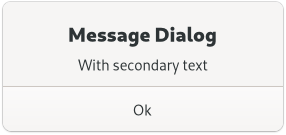
It’s simply a convenience widget; you could construct the equivalent of
GtkMessageDialog from GtkDialog without too much effort, but
GtkMessageDialog saves typing.
The easiest way to do a modal message dialog is to use the DialogFlags.MODAL
flag, which will call Window.setModal(boolean) internally. The dialog will
prevent interaction with the parent window until it's hidden or destroyed.
You can use the Gtk.Dialog::response signal to know when the user
dismissed the dialog.
An example for using a modal dialog:
GtkDialogFlags flags = GTK_DIALOG_DESTROY_WITH_PARENT | GTK_DIALOG_MODAL;
 dialog = gtk_message_dialog_new (parent_window,
                                  flags,
                                  GTK_MESSAGE_ERROR,
                                  GTK_BUTTONS_CLOSE,
                                  "Error reading “%s”: %s",
                                  filename,
                                  g_strerror (errno));
 // Destroy the dialog when the user responds to it
 // (e.g. clicks a button)

 g_signal_connect (dialog, "response",
                   G_CALLBACK (gtk_window_destroy),
                   NULL);
You might do a non-modal GtkMessageDialog simply by omitting the
DialogFlags.MODAL flag:
GtkDialogFlags flags = GTK_DIALOG_DESTROY_WITH_PARENT;
 dialog = gtk_message_dialog_new (parent_window,
                                  flags,
                                  GTK_MESSAGE_ERROR,
                                  GTK_BUTTONS_CLOSE,
                                  "Error reading “%s”: %s",
                                  filename,
                                  g_strerror (errno));

 // Destroy the dialog when the user responds to it
 // (e.g. clicks a button)
 g_signal_connect (dialog, "response",
                   G_CALLBACK (gtk_window_destroy),
                   NULL);
GtkMessageDialog as GtkBuildable
The GtkMessageDialog implementation of the GtkBuildable interface exposes
the message area as an internal child with the name “message_area”.
-
Nested Class Summary
Nested ClassesModifier and TypeClassDescriptionstatic classMessageDialog.Builder<B extends MessageDialog.Builder<B>>Deprecated.Inner class implementing a builder pattern to construct a GObject with properties.static classDeprecated.Nested classes/interfaces inherited from class org.gnome.gtk.Dialog
Dialog.CloseCallback, Dialog.DialogClass, Dialog.ResponseCallbackNested classes/interfaces inherited from class org.gnome.gtk.Window
Window.ActivateDefaultCallback, Window.ActivateFocusCallback, Window.CloseRequestCallback, Window.EnableDebuggingCallback, Window.KeysChangedCallback, Window.WindowClassNested classes/interfaces inherited from class org.gnome.gtk.Widget
Widget.DestroyCallback, Widget.DirectionChangedCallback, Widget.HideCallback, Widget.KeynavFailedCallback, Widget.MapCallback, Widget.MnemonicActivateCallback, Widget.MoveFocusCallback, Widget.QueryTooltipCallback, Widget.RealizeCallback, Widget.ShowCallback, Widget.StateFlagsChangedCallback, Widget.UnmapCallback, Widget.UnrealizeCallback, Widget.Widget$Impl, Widget.WidgetClassNested classes/interfaces inherited from class org.gnome.gobject.InitiallyUnowned
InitiallyUnowned.InitiallyUnownedClassNested classes/interfaces inherited from class org.gnome.gobject.GObject
GObject.NotifyCallback, GObject.ObjectClassNested classes/interfaces inherited from interface org.gnome.gtk.Accessible
Accessible.Accessible$Impl, Accessible.AccessibleInterfaceNested classes/interfaces inherited from interface org.gnome.gtk.Buildable
Buildable.Buildable$Impl, Buildable.BuildableIfaceNested classes/interfaces inherited from interface org.gnome.gtk.ConstraintTarget
ConstraintTarget.ConstraintTarget$Impl, ConstraintTarget.ConstraintTargetInterfaceNested classes/interfaces inherited from interface org.gnome.gtk.Native
Native.Native$Impl, Native.NativeInterfaceNested classes/interfaces inherited from interface org.gnome.gtk.Root
Root.Root$Impl, Root.RootInterfaceNested classes/interfaces inherited from interface org.gnome.gtk.ShortcutManager
ShortcutManager.ShortcutManager$Impl, ShortcutManager.ShortcutManagerInterface -
Constructor Summary
ConstructorsConstructorDescriptionDeprecated.Creates a new MessageDialog.MessageDialog(MemorySegment address) Deprecated.Create a MessageDialog proxy instance for the provided memory address.MessageDialog(@Nullable Window parent, Set<DialogFlags> flags, MessageType type, ButtonsType buttons, @Nullable String messageFormat, Object... varargs) Deprecated.UseAlertDialoginsteadMessageDialog(@Nullable Window parent, DialogFlags flags, MessageType type, ButtonsType buttons, @Nullable String messageFormat, Object... varargs) Deprecated.UseAlertDialoginstead -
Method Summary
Modifier and TypeMethodDescriptionprotected MessageDialogasParent()Deprecated.Returns this instance as if it were its parent type.static MessageDialog.Builder<? extends MessageDialog.Builder> builder()Deprecated.AMessageDialog.Builderobject constructs aMessageDialogwith the specified properties.voidformatSecondaryMarkup(String messageFormat, Object... varargs) Deprecated.UseAlertDialoginsteadvoidformatSecondaryText(@Nullable String messageFormat, Object... varargs) Deprecated.UseAlertDialoginsteadstatic MemoryLayoutDeprecated.The memory layout of the native struct.Deprecated.UseAlertDialoginsteadstatic @Nullable TypegetType()Deprecated.Get the GType of the MessageDialog classvoidDeprecated.UseAlertDialoginsteadstatic MessageDialogwithMarkup(@Nullable Window parent, Set<DialogFlags> flags, MessageType type, ButtonsType buttons, @Nullable String messageFormat, Object... varargs) Deprecated.UseAlertDialoginsteadstatic MessageDialogwithMarkup(@Nullable Window parent, DialogFlags flags, MessageType type, ButtonsType buttons, @Nullable String messageFormat, Object... varargs) Deprecated.UseAlertDialoginsteadMethods inherited from class org.gnome.gtk.Dialog
addActionWidget, addButton, addButtons, close, emitClose, emitResponse, getContentArea, getHeaderBar, getResponseForWidget, getWidgetForResponse, onClose, onResponse, response, setDefaultResponse, setResponseSensitive, withButtons, withButtonsMethods inherited from class org.gnome.gtk.Window
activateDefault, activateFocus, closeRequest, destroy, emitActivateDefault, emitActivateFocus, emitCloseRequest, emitEnableDebugging, emitKeysChanged, enableDebugging, fullscreen, fullscreenOnMonitor, getApplication, getChild, getDecorated, getDefaultIconName, getDefaultSize, getDefaultWidget, getDeletable, getDestroyWithParent, getFocus, getFocusVisible, getGravity, getGroup, getHandleMenubarAccel, getHideOnClose, getIconName, getMnemonicsVisible, getModal, getResizable, getTitle, getTitlebar, getToplevels, getTransientFor, hasGroup, isActive, isFullscreen, isMaximized, isSuspended, keysChanged, listToplevels, maximize, minimize, onActivateDefault, onActivateFocus, onCloseRequest, onEnableDebugging, onKeysChanged, present, presentWithTime, setApplication, setAutoStartupNotification, setChild, setDecorated, setDefaultIconName, setDefaultSize, setDefaultWidget, setDeletable, setDestroyWithParent, setDisplay, setFocus, setFocusVisible, setGravity, setHandleMenubarAccel, setHideOnClose, setIconName, setInteractiveDebugging, setMnemonicsVisible, setModal, setResizable, setStartupId, setTitle, setTitlebar, setTransientFor, unfullscreen, unmaximize, unminimizeMethods inherited from class org.gnome.gtk.Widget
actionSetEnabled, activateActionIfExists, activateWidget, addController, addCssClass, addMnemonicLabel, addTickCallback, allocate, childFocus, computeBounds, computeExpand, computeExpand, computePoint, computeTransform, contains, createPangoContext, createPangoLayout, cssChanged, directionChanged, disposeTemplate, dragCheckThreshold, emitDestroy, emitDirectionChanged, emitHide, emitKeynavFailed, emitMap, emitMnemonicActivate, emitMoveFocus, emitQueryTooltip, emitRealize, emitShow, emitStateFlagsChanged, emitUnmap, emitUnrealize, errorBell, focus, getAllocatedBaseline, getAllocatedHeight, getAllocatedWidth, getAllocation, getAncestor, getBaseline, getCanFocus, getCanTarget, getChildVisible, getClipboard, getColor, getCssClasses, getCssName, getCursor, getDefaultDirection, getDirection, getDisplay, getFirstChild, getFocusable, getFocusChild, getFocusOnClick, getFontMap, getFontOptions, getFrameClock, getHalign, getHasTooltip, getHeight, getHexpand, getHexpandSet, getLastChild, getLayoutManager, getLimitEvents, getMapped, getMarginBottom, getMarginEnd, getMarginStart, getMarginTop, getName, getNative, getNextSibling, getOpacity, getOverflow, getPangoContext, getParent, getPreferredSize, getPrevSibling, getPrimaryClipboard, getRealized, getReceivesDefault, getRequestMode, getRoot, getScaleFactor, getSensitive, getSettings, getSize, getSizeRequest, getStateFlags, getStyleContext, getTemplateChild, getTooltipMarkup, getTooltipText, getValign, getVexpand, getVexpandSet, getVisible, getWidth, grabFocus, hasCssClass, hasDefault, hasFocus, hasVisibleFocus, hide, inDestruction, initTemplate, insertActionGroup, insertAfter, insertBefore, isAncestor, isDrawable, isFocus, isSensitive, isVisible, keynavFailed, listMnemonicLabels, map, measure, mnemonicActivate, moveFocus, observeChildren, observeControllers, onDestroy, onDirectionChanged, onHide, onKeynavFailed, onMap, onMnemonicActivate, onMoveFocus, onQueryTooltip, onRealize, onShow, onStateFlagsChanged, onUnmap, onUnrealize, pick, pick, queryTooltip, queueAllocate, queueDraw, queueResize, realize, removeController, removeCssClass, removeMnemonicLabel, removeTickCallback, root, setCanFocus, setCanTarget, setChildVisible, setCssClasses, setCursor, setCursorFromName, setDefaultDirection, setDirection, setFocusable, setFocusChild, setFocusOnClick, setFontMap, setFontOptions, setHalign, setHasTooltip, setHexpand, setHexpandSet, setLayoutManager, setLimitEvents, setMarginBottom, setMarginEnd, setMarginStart, setMarginTop, setName, setOpacity, setOverflow, setParent, setReceivesDefault, setSensitive, setSizeRequest, setStateFlags, setStateFlags, setTooltipMarkup, setTooltipText, setValign, setVexpand, setVexpandSet, setVisible, shouldLayout, show, sizeAllocate, sizeAllocate, snapshot, snapshotChild, stateFlagsChanged, systemSettingChanged, translateCoordinates, triggerTooltipQuery, unmap, unparent, unrealize, unroot, unsetStateFlags, unsetStateFlagsMethods inherited from class org.gnome.gobject.GObject
addToggleRef, addWeakPointer, bindProperty, bindProperty, bindProperty, bindPropertyFull, bindPropertyFull, bindPropertyWithClosures, bindPropertyWithClosures, compatControl, connect, connect, connect, constructed, disconnect, dispatchPropertiesChanged, dispose, dupData, dupQdata, emit, emitNotify, finalize_, forceFloating, freezeNotify, get, getData, getProperty, getProperty, getProperty, getQdata, getv, interfaceFindProperty, interfaceInstallProperty, interfaceListProperties, isFloating, newInstance, newInstance, newv, notify, notify, notifyByPspec, onNotify, ref, refSink, removeToggleRef, removeWeakPointer, replaceData, replaceQdata, runDispose, set, setData, setDataFull, setProperty, setProperty, setProperty, setQdata, setQdataFull, setv, stealData, stealQdata, takeRef, thawNotify, unref, watchClosure, weakRef, weakUnref, withPropertiesMethods inherited from class org.gnome.gobject.TypeInstance
callParent, callParent, cast, getPrivate, readGClass, writeGClassMethods inherited from class org.javagi.base.ProxyInstance
equals, handle, hashCodeMethods inherited from class java.lang.Object
clone, finalize, getClass, notify, notifyAll, toString, wait, wait, waitMethods inherited from interface org.gnome.gtk.Accessible
announce, getAccessibleParent, getAccessibleRole, getAtContext, getBounds, getFirstAccessibleChild, getNextAccessibleSibling, getPlatformState, resetProperty, resetRelation, resetState, setAccessibleParent, updateNextAccessibleSibling, updatePlatformState, updateProperty, updateRelation, updateStateMethods inherited from interface org.gnome.gtk.Buildable
getBuildableIdMethods inherited from interface org.gnome.gtk.Native
getRenderer, getSurface, getSurfaceTransform, realize, unrealizeMethods inherited from interface org.gnome.gtk.Root
getDisplay, getFocus, setFocus
-
Constructor Details
-
MessageDialog
Deprecated.Create a MessageDialog proxy instance for the provided memory address.- Parameters:
address- the memory address of the native object
-
MessageDialog
@Deprecated public MessageDialog(@Nullable Window parent, Set<DialogFlags> flags, MessageType type, ButtonsType buttons, @Nullable String messageFormat, Object... varargs) Deprecated.UseAlertDialoginsteadCreates a new message dialog.This is a simple dialog with some text the user may want to see. When the user clicks a button a “response” signal is emitted with response IDs from
Gtk.ResponseType. SeeDialogfor more details.- Parameters:
parent- transient parentflags- flagstype- type of messagebuttons- set of buttons to usemessageFormat- printf()-style format stringvarargs- arguments formessageFormat
-
MessageDialog
@Deprecated public MessageDialog(@Nullable Window parent, DialogFlags flags, MessageType type, ButtonsType buttons, @Nullable String messageFormat, Object... varargs) Deprecated.UseAlertDialoginsteadCreates a new message dialog.This is a simple dialog with some text the user may want to see. When the user clicks a button a “response” signal is emitted with response IDs from
Gtk.ResponseType. SeeDialogfor more details.- Parameters:
parent- transient parentflags- flagstype- type of messagebuttons- set of buttons to usemessageFormat- printf()-style format stringvarargs- arguments formessageFormat
-
MessageDialog
public MessageDialog()Deprecated.Creates a new MessageDialog.
-
-
Method Details
-
getType
Deprecated.Get the GType of the MessageDialog class- Returns:
- the GType
-
getMemoryLayout
Deprecated.The memory layout of the native struct.- Returns:
- the memory layout
-
asParent
Deprecated.Returns this instance as if it were its parent type. This is mostly synonymous to the Javasuperkeyword, but will set the native typeclass function pointers to the parent type. When overriding a native virtual method in Java, "chaining up" withsuper.methodName()doesn't work, because it invokes the overridden function pointer again. To chain up, callasParent().methodName(). This will call the native function pointer of this virtual method in the typeclass of the parent type. -
withMarkup
@Deprecated public static MessageDialog withMarkup(@Nullable Window parent, Set<DialogFlags> flags, MessageType type, ButtonsType buttons, @Nullable String messageFormat, Object... varargs) Deprecated.UseAlertDialoginsteadCreates a new message dialog.This is a simple dialog with some text that is marked up with Pango markup. When the user clicks a button a “response” signal is emitted with response IDs from
Gtk.ResponseType. SeeDialogfor more details.Special XML characters in the printf() arguments passed to this function will automatically be escaped as necessary. (See g_markup_printf_escaped() for how this is implemented.) Usually this is what you want, but if you have an existing Pango markup string that you want to use literally as the label, then you need to use
setMarkup(java.lang.String)instead, since you can’t pass the markup string either as the format (it might contain “%” characters) or as a string argument.GtkWidget *dialog; GtkDialogFlags flags = GTK_DIALOG_DESTROY_WITH_PARENT; dialog = gtk_message_dialog_new (parent_window, flags, GTK_MESSAGE_ERROR, GTK_BUTTONS_CLOSE, NULL); gtk_message_dialog_set_markup (GTK_MESSAGE_DIALOG (dialog), markup);- Parameters:
parent- transient parentflags- flagstype- type of messagebuttons- set of buttons to usemessageFormat- printf()-style format stringvarargs- arguments formessageFormat- Returns:
- a new
GtkMessageDialog
-
withMarkup
@Deprecated public static MessageDialog withMarkup(@Nullable Window parent, DialogFlags flags, MessageType type, ButtonsType buttons, @Nullable String messageFormat, Object... varargs) Deprecated.UseAlertDialoginsteadCreates a new message dialog.This is a simple dialog with some text that is marked up with Pango markup. When the user clicks a button a “response” signal is emitted with response IDs from
Gtk.ResponseType. SeeDialogfor more details.Special XML characters in the printf() arguments passed to this function will automatically be escaped as necessary. (See g_markup_printf_escaped() for how this is implemented.) Usually this is what you want, but if you have an existing Pango markup string that you want to use literally as the label, then you need to use
setMarkup(java.lang.String)instead, since you can’t pass the markup string either as the format (it might contain “%” characters) or as a string argument.GtkWidget *dialog; GtkDialogFlags flags = GTK_DIALOG_DESTROY_WITH_PARENT; dialog = gtk_message_dialog_new (parent_window, flags, GTK_MESSAGE_ERROR, GTK_BUTTONS_CLOSE, NULL); gtk_message_dialog_set_markup (GTK_MESSAGE_DIALOG (dialog), markup);- Parameters:
parent- transient parentflags- flagstype- type of messagebuttons- set of buttons to usemessageFormat- printf()-style format stringvarargs- arguments formessageFormat- Returns:
- a new
GtkMessageDialog
-
formatSecondaryMarkup
Deprecated.UseAlertDialoginsteadSets the secondary text of the message dialog.The
messageFormatis assumed to contain Pango markup.Due to an oversight, this function does not escape special XML characters like
withMarkup(org.gnome.gtk.Window, java.util.Set<org.gnome.gtk.DialogFlags>, org.gnome.gtk.MessageType, org.gnome.gtk.ButtonsType, java.lang.String, java.lang.Object...)does. Thus, if the arguments may contain special XML characters, you should use g_markup_printf_escaped() to escape it.char *msg; msg = g_markup_printf_escaped (message_format, ...); gtk_message_dialog_format_secondary_markup (message_dialog, "%s", msg); g_free (msg);- Parameters:
messageFormat- printf()-style string with Pango markupvarargs- arguments formessageFormat
-
formatSecondaryText
Deprecated.UseAlertDialoginsteadSets the secondary text of the message dialog.- Parameters:
messageFormat- printf()-style format stringvarargs- arguments formessageFormat
-
getMessageArea
Deprecated.UseAlertDialoginsteadReturns the message area of the dialog.This is the box where the dialog’s primary and secondary labels are packed. You can add your own extra content to that box and it will appear below those labels. See
Dialog.getContentArea()for the corresponding function in the parentDialog.- Returns:
- A
GtkBoxcorresponding to the “message area” in the this MessageDialog
-
setMarkup
Deprecated.UseAlertDialoginsteadSets the text of the message dialog.- Parameters:
str- string with Pango markup
-
builder
Deprecated.AMessageDialog.Builderobject constructs aMessageDialogwith the specified properties. Use the variousset...()methods to set properties, and finish construction withMessageDialog.Builder.build().- Returns:
- the builder object
-
AlertDialoginstead